Safety Deposit Box Cost
Coming in different sizes to fit your belongings, safety deposit boxes act as locked safes at the bank where you have access during regular business hours. The typical safe deposit box cost can vary based on factors like the size, bank and your status as a customer, but can run up to $200 annually. Banks usually have you sign a lease agreement. Rent in United States Pobox: Find a USPS Post Office Location for United States Postal Service: Rent a Safe Deposit box at a USPS Post office.Get shipping rates, buy stamps, print postage, track a package, look up a ZIP Code? Schedule an appointment with an associate at your local financial center for a day and time that work best for you or call us at 800.432.1000 (Mon-Fri 8 a.m.-11 p.m. Or Sat-Sun 8 a.m.8 p.m., all times ET). Outside the U.S. Call 1.315.724.4022 (international collect; cell phone roaming charges may apply). The key benefit of a safe deposit box is that you get to take advantage of your bank's state of the art security systems – all for a nominal annual fee starting as low as $20 or $30.
Share
A safety deposit box, also known as a safe deposit box, is an individually locked box held within a larger vault, usually in a bank. The boxes come in a range of sizes and can be rented on an annual basis. People use them to store valuables, documents and other valuable items they want to be kept safe. Read on for more information on how much they cost, where you can rent one and why you might need one.
Are Safety Deposit Boxes Secure?
In terms of access, safety deposit boxes are very secure. Typically, each comes with two keys needed to open the box: one held by the bank and the other held by you, the box’s owner. When you go into the bank to access a safety deposit box, banks require identification. If someone else needs to access your box, they will need prior authorization from you. For extra security, don’t put any identifying information on your safe deposit box key, like the box number or bank’s name. This way, if you lose your key or someone steals it, no one will know what it belongs to.
Safety deposit boxes are housed in vaults with thick doors and walls, reinforced to keep them safe during hurricanes, tornadoes and other natural disasters. However, no space is entirely safe from natural disasters. You may want to place your items in waterproof containers to prevent water damage.
This might not sound any better than placing items in a safe at your own home. However, a thief can more easily break into your home and home safe than into a bank vault and deposit box. In case of a home robbery, robbers could force you to open your home safe or take the safe and open it by other means. Even if robbers broke into a bank’s vault, they could not open your deposit box without your key.
Storing items in a safe deposit box does offer a safe physical space for your valuables. However, in the event that they are somehow stolen, they may be less protected. Neither the bank nor the FDIC insure the contents of safety deposit boxes. Banks will not reimburse you for theft or damage, either. If you want to insure your items, you’ll need to get that coverage yourself. You can find a property insurance agency, a safety deposit box-specific agency or add a special policy to your homeowners insurance.
What Should You Store in a Safety Deposit Box?
Due to their secure nature, safe deposit boxes are an ideal place to store valuables and important documents. People typically store personal and property files, including original birth certificates, insurance policies, property deeds, car titles and U.S. bonds. You can also store items like gold coins, family heirlooms and photo negatives. Again, you may want to place paper items in waterproof containers for extra protection.
You shouldn’t use a safety deposit box to store passports, revocable living wills and powers of attorney. These are documents that need to be reached without jumping through too many hoops. You also should avoid storing cash in your safe deposit box. Not only is it against the rules of many banks, it’s also safer in an FDIC-insured bank account. Plus, stashing cash in a high-yield savings account can grow your money rather than let it sit idly.
Do not use safety deposit boxes to store any items you might need quickly, especially in an emergency. You can only access your safety deposit box during the bank’s business hours. If an emergency comes up in the middle of the night and you need something from your safety deposit box, you won’t be able to access it until the morning.
It’s important to remember that no one can get into your safety deposit box unless you have pre-authorized them. Therefore, you may not want to store anything like medical directives or funeral arrangements. In those cases, you may not have time to pre-authorize anyone to access those documents. If you absolutely want to place these documents in a safety deposit box, you may want to authorize a trusted partner to access your safe deposit box in case of an emergency. That can minimize the risk of losing the box’s contents.
How Much Do Safety Deposit Boxes Cost to Rent?
The cost to rent a safety deposit box depends on the size of the box and location of your bank, ranging from about $20 for a small box to $200 for a large one. A small box is typically 3 inches by 5 inches, the size of an index card, and a foot long. Safe deposit boxes come in a range of sizes up from there, with the largest being 10 inches by 10 inches and two feet deep.
Prices not only differ between banks but can also vary by bank location. You should call your local bank branch to find out the annual rental costs for their safety deposit boxes. If you have a checking account, it may include a free or discounted box in its perks. If you don’t pay your rent for the box, the bank will seize the contents, so be sure to pay.
The table below has common rent prices for a safety deposit box at six major banks. Again, actual prices and availability will vary by bank and by location.
| Average Safety Deposit Box Prices | |||||
| Box Size (inches): | 3×5 | 5×5 | 3×10 | 5×10 | 10×10 |
| Bank of America | $77 | $104 | – | $152 | $192 |
| Chase | $83 | – | $140 | $220 | $350 |
| Wells Fargo | $60 | – | $55 | $100 | – |
| PNC | $40 | – | – | – | $110 |
| TD Bank | $58 | $90 | $130 | $158 | $275 |
| BB&T | $40 | $50 | $55 | $70 | $115 |
Where Can I Rent a Safety Deposit Box?
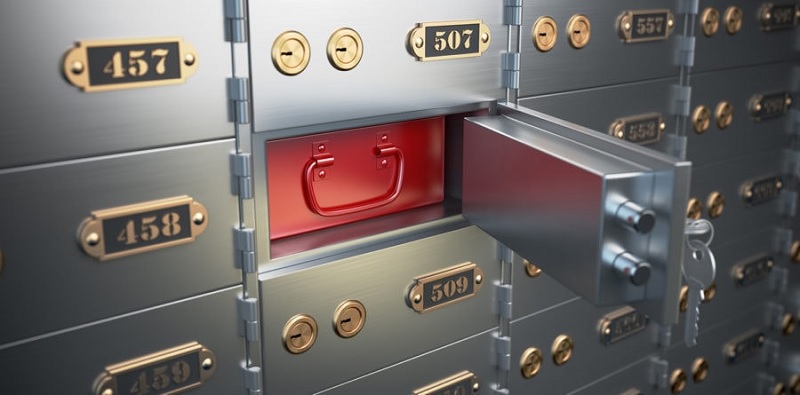

The safest place to rent a safety deposit box is a bank where you have an account. Banks specialize in storing money and they typically have dedicated, secured vaults for safety deposit boxes. If you want to rent a safety deposit box, call or visit your local bank branch. Often, there are waiting lists for safety deposit boxes. This means you may not get a box at the same time you go to open one. You may even decide to shop around to find a bank with available space.
If you just need to store copies of important documents and information, you can also try a virtual safety deposit box. Fidelity is one company that offers this service, providing free encrypted storage space to users. This is a convenient way to keep copies of files like birth certificates, passports, property deeds and more. An added benefit is the ability to access the files from any computer in the world, in case of emergency while traveling.
Bottom Line
Safety Deposit Box Cost Bank
Safety deposit boxes offer a secure place to store your most valuable items. Banks and their heavily protected vaults are designed to protect its contents safe from theft and natural disasters. However, it’s not ideal for all valuable items, like passports or your will. You’ll still want to keep these items safe, of course, just more accessible than in a safety deposit box. If you’re thinking about opening a safety deposit box with your bank, you should call sooner rather than later since there may be a wait list.
Tips for Safe Banking
- No matter where you bank, your money and information are at risk of being stolen and used by fraudsters. Monitor your checking and savings accounts periodically and check your bank statements carefully to ensure you have authorized each transaction.
- If you’re ever transferring money electronically, you’ll want to make sure you know exactly who you’re sending it to. This is especially true for transactions like wire transfers, where it’s crucial you have all the correct information.
Photo credit: ©iStock.com/simonkr, ©iStock.com/kali9, ©iStock.com/Tashi-Delek
Where do you keep your birth certificate? Passport? Maybe you are finding it harder to trust the bank with anything these days, and even have your cash stuffed in the mattress. However, there are still plenty of good reasons to keep some of your most vital documents locked up under the watchful eye of the bank.
There are some drawbacks, of course, to having your access to important items and papers somewhat restricted and only accessible during bank hours, so you need to know which things to keep close to home and which ones you can manage without for a few days.
Some are quick to point out other problems that can arise when you don’t take matters into your own hands, but we will help you make your own choice and decide if a safe deposit box at least beats the mattress and a plastic filing cabinet for security, or at least point you to some basics for safer storage within your home.
Opening a Safe Deposit Box
Most banks and credit unions offer the service, and may even give discounts to existing customers, so start with your current bank. It is really important to plan ahead and give permission to someone you trust to access the safe deposit box or at least have an executed power of attorney that allows them to easily get to the contents.
This is especially important in case of death so that important papers and heirlooms can be accessed without delays. Consult with an attorney to determine state laws that affect the ability of your loved ones to gain access if you have reasons for not granting them access while you are alive.
The annual cost will typically range anywhere from $30 to $75 and you should also contact your insurance agent because the contents are not covered by the generous new $250,000 in FDIC coverage that you get, and most causes for loss within the bank will not be deemed to be the bank’s responsibility. Because neither the bank nor the insurance company will likely cover flood damage, make sure to put all contents in sealed plastic bags.
What You Should Put in the Safe Deposit Box
A good rule of thumb to keep in mind that is grounded in common sense is to view your safe deposit box as the repository for stuff that you really need, but will not likely ever need on a moment’s notice. Items that are a pain to get replaced such as birth certificates and other family records definitely belong here.
Safety Deposit Box Cost Chase
Another important item to remember for insurance purposes is a videotape of your home’s content for insurance purposes, and a copy of this video definitely belongs in your safe deposit box. Contracts, stocks, bonds, certificates of deposit, original deeds to property, collectibles and rare jewels are also commonly kept in safe deposit boxes. If your grandmother gave you a pouch of diamonds or if you have negatives from your honeymoon that aren’t safe for the film lab then lock it all up at the bank! For that matter, you can put just about anything you want in the box.
What Does Not Go in My Safe Deposit Box?
There are plenty of things that obviously do not belong in the safe deposit box that we do not need to go into for the sake of brevity i.e. food, pets and cash you are hiding to dodge paying taxes, although the latter is certainly a common but unethical choice.
You certainly can place copies but should never put originals or your only copy of medical care instructions, burial preferences or original Power of Attorney documents. Further, if you live your life like you are starring in Bourne Supremacy (or simply have friends and family overseas that you would visit in an emergency), you definitely don’t want your passport locked up overnight, let alone a three-day weekend.
You Don’t Understand Me…There Is No Way I Am Keeping My Valuables at the Bank
Would you rather just bury it all in the backyard? If the thought of a bank robbery or putting your great-grandfather’s watch in a dark box somewhere makes you simply too uncomfortable, then it is time to shop for a fireproof safe and make sure that you get adequate insurance coverage to keep these items in your home. If you purchase an inexpensive safe, you might end up regretting the move as many of these safes only withstand an hour in a fire – not good if your videotape of the home’s contents gets melted in a fire in said home.
However, there are some heavy duty safes that can only be hacked into by Tom Cruise that will also give you the necessary levels of protection (UL125) to protect your computer data. You can check here and here for more information on choosing a fireproof safe, and make sure that you don’t buy a safe that is too small to contain any gold bars you plan on purchasing in the next few years.
So, remember to either get the safe deposit box along with a separate insurance policy, or do some research and get a fireproof safe that will protect digital information and film negatives (not just your paperwork) and insure the contents. Make sure that you are protected – this is not an item to put on the “vague list of important stuff to eventually take care of down the road.”
Sign up for Mint today
From budgets and bills to free credit score and more, you’ll
discover the effortless way to stay on top of it all.